Machine Asset / 01
Automatic Vacuum Leak Tester
Industrial testing machinery with multiple processing stations and control units.
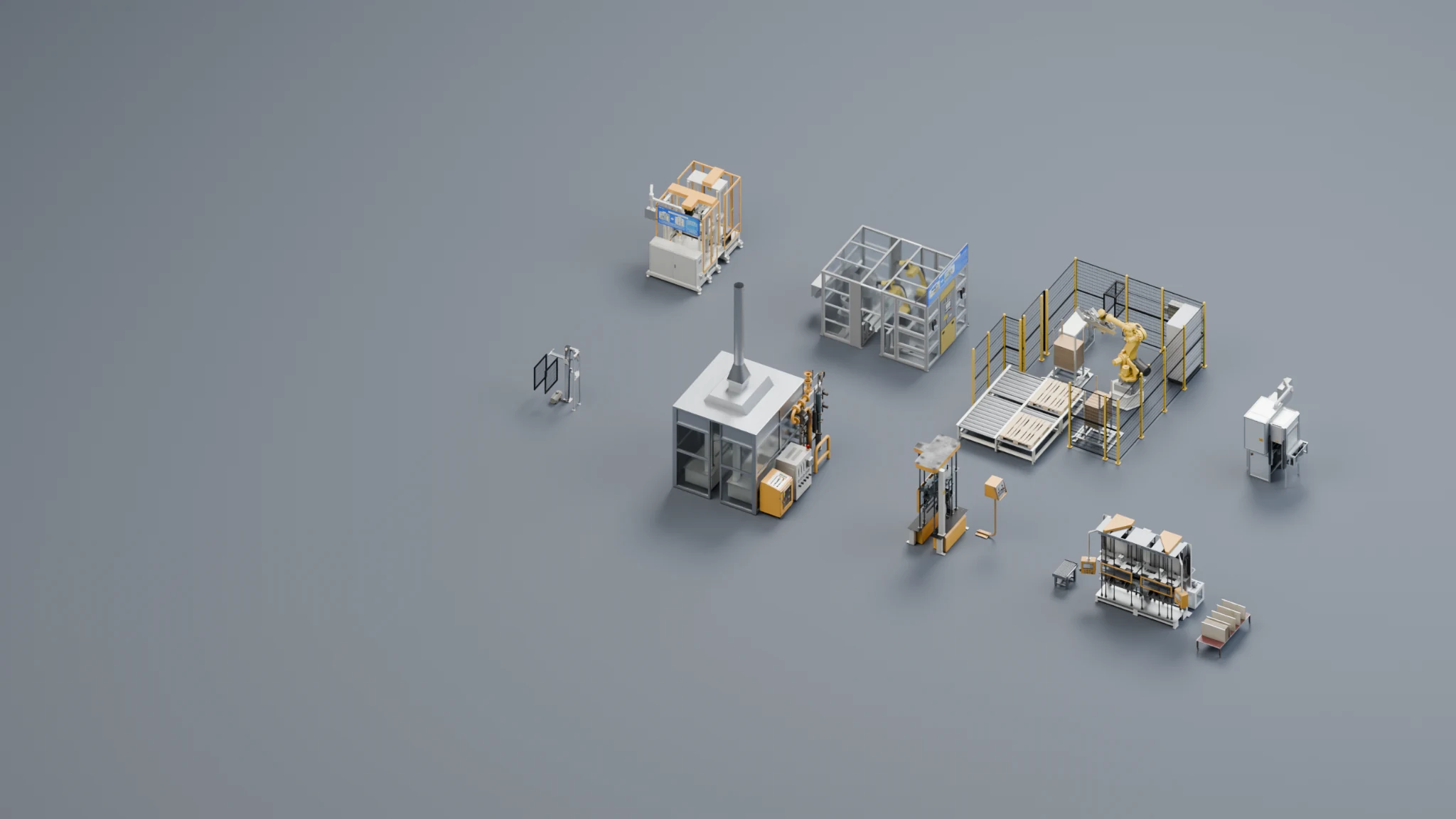
Photo-referenced industrial machinery developed for a connected manufacturing simulation and digital twin ecosystem.
Building the visual foundation of a manufacturing digital twin.
This project translated industrial machinery and production systems into a real-time 3D environment designed for simulation, visualization and software integration.
Using reference photographs of real equipment, I modeled manufacturing machines in Blender, created PBR materials in Substance 3D Painter, and integrated the assets into Unity. Optimized low-poly versions were also prepared for web use, alongside assets for a tablet application.
The broader digital twin system was connected to real production data, enabling software-driven monitoring and calculations of machine operation and efficiency.
A selection of the individual manufacturing assets created from real-world references. The composition below presents the modeled equipment as a collection, rather than a literal diagram of its physical production-line routing.
Each machine was developed as an individual 3D asset, balancing recognizable mechanical structure with real-time requirements.
The consistent visual treatment allows the assets to function as a unified library while retaining the details, proportions and surface characteristics of their physical references.
Selected modeling work across testing, processing, automation and robotic handling equipment.
Industrial testing machinery with multiple processing stations and control units.
Industrial robot, protective enclosure, handling structures and conveyor equipment.
Machine enclosure, control hardware and structural components modeled for real-time use.
Photo-referenced vertical equipment, safety barriers, motor and cable systems.
Transparent safety enclosure with visible internal components and an external control unit.
Industrial equipment housing, integrated controls and supporting structural elements.
Close-up studies reveal the mechanical construction, material separation and component-level work behind the full machine models.
Detailed modeling of robotic joints, handling structures and surrounding safety equipment.
Material detailing across painted frames, exposed metal, transparent panels and worn industrial surfaces.
An asset production pipeline developed for real-time integration and collaboration with software developers.
Studying real machine photographs and identifying primary mechanical components.
Modeling machinery, assemblies and production equipment as 3D assets.
Creating PBR materials and surface variations in Substance 3D Painter.
Integrating assets into the real-time environment and preparing platform-specific versions.
Coordinating asset integration and version-controlled work with developers.
The 3D production pipeline supported applications with different performance and presentation needs.
Detailed machine assets were prepared for the tablet application, while lower-polygon versions were developed for web deployment. This allowed the industrial equipment to retain its essential visual identity across platforms.
The visual assets formed part of a broader, software-connected manufacturing digital twin.
The wider solution integrated real manufacturing data with software tools for evaluating machine operation, performance and production efficiency.
A web-based administration interface enabled monitoring and calculations associated with the production system. The software functionality was developed collaboratively with the development team.
The machine renders on this page document 3D asset production. Administration software screenshots are not included.
My work focused on producing the 3D and technical-art foundation required by the digital twin applications.
I collaborated with the development team throughout asset integration, using GitHub to coordinate the workflow.