In a museum flight exhibit, an animated bee guided visitors better than written instructions did. My working explanation is that following the bee was part of flying.
The problem
At the Agricultural History Museum in Orhangazi, Bursa, we built an exhibit where visitors flew as a bee, a dragonfly or a butterfly over an organic farm. A Kinect depth camera tracked one visitor at a time in front of a large projection, and they steered by leaning, turning and changing posture. During development, visitors loved the freedom. They also flew wherever they liked and lost the route the exhibit was built around.
What we tried
We compared two ways of bringing drifting visitors back: written instructions, and an animated bee that appeared when they drifted and flew ahead of them. The bee never steered or slowed anyone. Leaning still turned the insect. Visitors followed the bee more readily than the text.
Some still left the route, and when we watched them, they had seen the bee and grown bored with it. Only then did we bound the flight area. Visitors who reached the boundary were surprised and turned back. These were observations made during development, not a formal study.
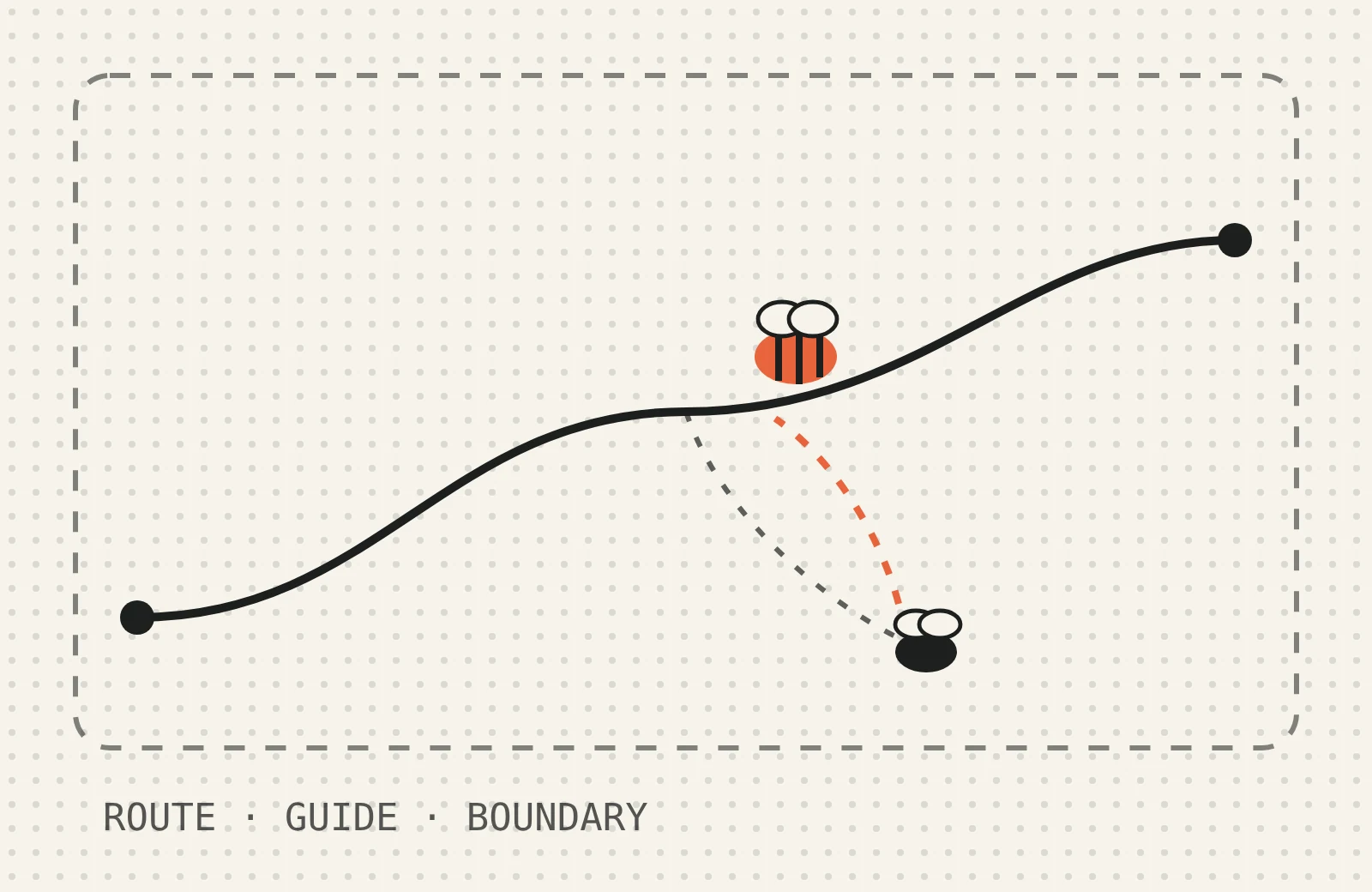
The three steps of the final design, in the order we added them.
Why the bee may have worked
Written instructions asked visitors to stop flying and start reading. The bee let them keep flying. It used the same kind of action, it lived in the same world, and the world gave a reason to follow it: one insect following another.
A simpler explanation is that a moving bee is easier to notice than text, and I cannot rule that out. One impression points the other way. Visitors flying as a dragonfly or a butterfly seemed to follow the bee less readily than visitors flying as a bee, even though all three insects used the same posture mapping and speed. Visitors chose their own insect, though, so the ones who picked the bee may simply have been the most willing to follow one.
The three steps also act on different things. The bee changes where a visitor wants to go. The boundary changes what their movement does. A guide that can be refused will sometimes be refused, and that is the price of leaving control with the visitor.
The same question elsewhere
In a Unity golf simulator I helped design at Rapsodo, the settings lived on a tablet that did not register a gloved finger, and players hit runs of shots with a club in hand. The swing leaves no room for guidance, so I proposed moving the choice to a profile at the start of each session. Most players kept the defaults. Players focused on distance, precision or full holes chose different metrics.
In a LIDAR game at the same museum, children threw balls at harmful bacteria and soon started hitting the beneficial ones on purpose, just to see their animations. The consequence had turned into a reward, so we made hitting a beneficial organism cost points.
In another Kinect exhibit, the sensor also read people walking behind the visitor. We limited its depth and put a mark on the floor. Visitors stood on it without being told.
| Activity | Where guidance can go | Example |
|---|---|---|
| Acting | A consequence in the world, after the action | Points lost in the bacteria game |
| Exploring | In the world, during the action, easy to ignore | The guide bee |
| Choosing | Before the action, with a suggested default | A suggested room arrangement in a VR support app |
| Performing | Before or after the action, never during it | The golf session profile |
What I take from it
Guidance seems to cost the least when following it is already part of what people are doing and the world gives them a reason to follow. When the action leaves no room, the guidance has to move to where the body is free. And no guide can make a dull destination worth reaching.
The test I would like to run next is simple: keep the guide the same and change only the insect the visitor flies as. If the bee helps bee flyers more than butterfly flyers, the reason to follow matters. If it helps both equally, it was mostly about being easy to see.
From the project
The exhibits behind this note.
- Interactive Museum Installations · Guidance and design decisions yigitacet.com
- Rapsodo Sports Simulation yigitacet.com